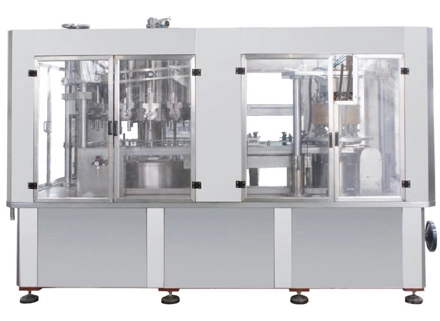
For food and beverage manufacturers seeking higher productivity, better packaging consistency, and lower operating costs, an Automatic Filling and Sealing Unit provides significant advantages over traditional filling machines. Compared with conventional filling equipment that requires more manual intervention and separate sealing processes, the JQ4B250 integrates filling and sealing operations into one automated system, helping factories achieve faster production, improved hygiene control, and more stable product quality.
As modern food processing continues to demand higher efficiency and stricter packaging standards, choosing the right industrial food machinery has become a critical decision for manufacturers. The JQ4B250 Automatic Filling and Sealing Unit is designed to address these challenges by combining precision filling technology with reliable sealing performance for large-scale production environments.
What Is the Difference Between an Automatic Filling and Sealing Unit and Traditional Filling Machines?
The main difference lies in automation level, production efficiency, and process integration.
Traditional filling machines typically perform only one primary operation—filling. After containers are filled, manufacturers often need additional equipment or manual handling for sealing, which increases labor requirements, production time, and the risk of contamination.
An Automatic Filling and Sealing Unit, such as the JQ4B250, combines multiple processes into a continuous production line, including:
Automatic container positioning
Precise filling
Automatic cover or lid placement
Sealing operations
Continuous production output
This integrated design reduces the need for manual operations while improving packaging consistency. For manufacturers producing canned beverages, dairy products, sauces, and other liquid food products, an integrated filling and sealing solution offers a more efficient alternative to traditional equipment setups.
Why Does JQ4B250 Automatic Filling and Sealing Unit Improve Production Efficiency?
The JQ4B250 improves efficiency by optimizing the entire filling and sealing workflow instead of focusing on a single production step.
Traditional filling systems often create bottlenecks because filling and sealing are separated processes. Operators must transfer containers between machines, adjust different systems, and manage additional labor. These steps increase downtime and reduce overall line efficiency.
The JQ4B250 eliminates many of these challenges through automated operation. Its synchronized filling and sealing process allows manufacturers to:
Increase production speed
Reduce manual handling
Maintain consistent filling volumes
Minimize production interruptions
Improve overall equipment utilization
For factories looking to expand output without significantly increasing labor costs, investing in advanced industrial food machinery like the JQ4B250 can provide long-term operational advantages.
How Does JQ4B250 Ensure Better Filling Accuracy and Product Quality?
Filling accuracy directly affects product consistency, material costs, and customer satisfaction.
Traditional filling machines may experience variations caused by manual adjustments, operator experience, or unstable production conditions. Even small filling differences can result in product waste or inconsistent packaging.
The JQ4B250 is engineered for precise filling control, helping manufacturers maintain stable product quantities throughout the production cycle. Its automated system supports:
For food and beverage companies, this level of precision is especially important because accurate filling directly impacts profitability and compliance with packaging requirements.
Why Is Automated Sealing Important for Modern Food Production?
Sealing quality plays a major role in protecting products from contamination, leakage, and reduced shelf life.
With traditional production methods, sealing may require separate equipment or manual operation, creating additional quality control challenges. In contrast, an Automatic Filling and Sealing Unit provides a more controlled sealing process within the same production system.
The JQ4B250 helps manufacturers achieve:
More stable sealing performance
Reduced packaging defects
Improved product protection
Higher production hygiene standards
For industries such as canned food, beverages, and liquid products, reliable sealing technology is essential for maintaining product safety from production to distribution.
What Makes JQ4B250 Different from Other Filling and Sealing Machines?
The JQ4B250 stands out because it is designed around the practical needs of modern manufacturing facilities rather than only individual processing steps.
Key advantages include:
Integrated Filling and Sealing Process
By combining filling and sealing functions in one machine, JQ4B250 reduces equipment complexity and simplifies production management.
Efficient Space Utilization
Compared with multiple independent machines, an integrated unit requires less production space, making it suitable for factories optimizing their production layout.
Reliable Industrial Design
Built for continuous industrial applications, the machine supports stable operation in demanding production environments.
Easier Production Management
A unified control system allows operators to manage filling and sealing operations more efficiently, reducing training requirements and operational complexity.
These advantages make JQ4B250 a practical choice for companies upgrading from traditional filling solutions to modern automated production systems.
How to Choose the Right Filling Equipment for a Food Production Line?
Selecting filling equipment depends on several factors, including product type, container design, production capacity, and automation requirements.
Manufacturers should consider:
Production Volume Requirements
High-output factories generally benefit from automated solutions that can maintain consistent performance over long production cycles.
Product Characteristics
Different products may require specific filling technologies depending on viscosity, ingredients, and packaging requirements.
Packaging Efficiency
Equipment that integrates filling and sealing can reduce transfer processes and improve overall production flow.
Long-Term Operating Costs
Although traditional machines may have lower initial costs, automated systems often provide better value through reduced labor requirements, lower waste, and improved productivity.
For companies planning long-term growth, an advanced Automatic Filling and Sealing Unit offers greater flexibility and scalability.
Conclusion: Why JQ4B250 Is the Better Choice for Modern Filling Applications
The comparison between traditional filling machines and the JQ4B250 highlights the advantages of integrated automation. Traditional equipment may meet basic production needs, but modern manufacturers require higher efficiency, improved hygiene, and consistent packaging quality.
The JQ4B250 Automatic Filling and Sealing Unit provides a reliable solution by combining filling and sealing functions into one efficient system. For businesses investing in advanced industrial food machinery, it offers a practical way to improve production performance, reduce operational challenges, and support future manufacturing growth.
FAQ About Automatic Filling and Sealing Unit
What industries use automatic filling and sealing machines?
Automatic filling and sealing machines are widely used in:
They help manufacturers achieve faster production while maintaining strict hygiene and quality standards.
Why should manufacturers replace traditional filling machines?
Manufacturers often upgrade from traditional filling machines because automated filling and sealing equipment can reduce labor requirements, improve production speed, increase filling accuracy, and provide more consistent sealing quality.
What are the benefits of using JQ4B250 in food production?
The JQ4B250 offers integrated filling and sealing operations, stable production performance, improved packaging consistency, and efficient workflow management, making it suitable for manufacturers seeking reliable automation solutions.
.webp "How to Maintain and Service Can Sealing Machines")